
How AV Installers Can Win More High End Home Theater Jobs Online
How AV Installers Can Win More High End Home Theater Jobs Online
High-end home theater customers are not buying a television installation.
They are buying an experience.
They want the room to look right, sound right, work without a pile of remotes, and feel like somebody planned the entire system instead of hanging equipment on the wall one piece at a time.
That creates a marketing challenge for AV installers.
If your website looks like a handyman site, talks only about TV mounting, and shows stock photos of electronics, the customer shopping for a serious home theater may never realize you can build one.
Your online presence needs to reflect the level of project you want to sell.
Stop Marketing High-End AV Like a Commodity Service
There is nothing wrong with TV mounting if your company provides it.
But a $300 mounting job and a custom media room are different buying decisions.
A high-end homeowner may be considering:
- Dedicated home theater design
- Media room installation
- Whole-home audio
- Hidden or architectural speakers
- Projectors and large-format displays
- Video wall installation
- Lighting and shade integration
- Smart home control
- Networking and Wi-Fi
- Outdoor audio and video
- Acoustic treatment
- Equipment racks and structured wiring
If those are the projects you want, they should be obvious on the site.
A visitor should not have to click through a page titled “Other Services” to discover that your company designs six-figure entertainment systems.
Your Portfolio Should Sell the Experience
AV is one of the most visual home service categories.
Use that advantage.
Show real completed work whenever possible.
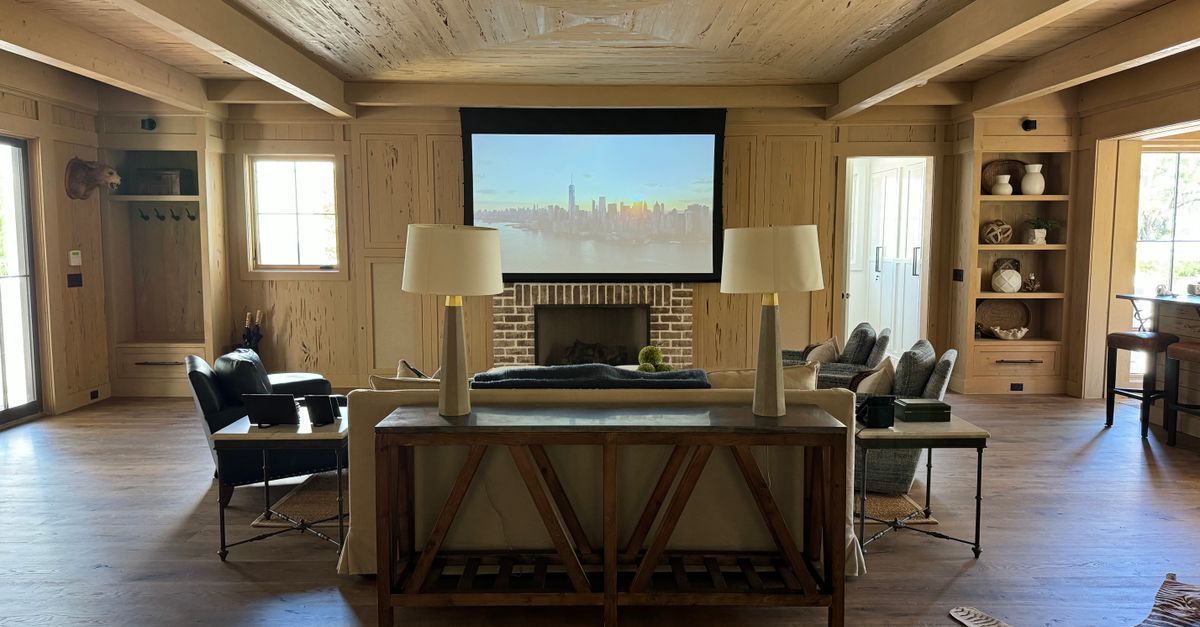
For home theaters, capture the room from several angles. Show seating, screen or projector placement, speakers, lighting, equipment integration, and the finished details.
For whole-home audio, show the clean finished spaces rather than only closeups of speaker grilles.
For video walls, show scale.
For smart-home work, show the environment and experience rather than a closeup of a generic tablet.
A strong project portfolio can include a short explanation:
What did the homeowner want?
What was installed?
What challenge did the room create?
How was the system designed to fit the space?
Do not disclose private customer information. “Custom home theater in Houston” is enough geographic context for many project examples.
Build Separate Pages for the Services High-End Buyers Research
A generic “Audio Video Services” page is not enough.
The customer researching a home theater has different questions from someone looking for whole-home audio.
A useful home theater page can discuss room planning, screen and projector options, speaker layout, seating considerations, lighting, control, calibration, acoustic treatment, and the consultation process.
A whole-home audio page can explain zones, architectural speakers, control options, outdoor areas, sources, retrofit versus new construction, and how the system fits daily use.
A video-wall page can explain residential and commercial use cases, display configurations, mounting, control, cable management, and what information the installer needs before quoting.
Do not turn the pages into manufacturer catalogs.
Explain what the system does for the customer.
Talk About Design, Not Just Equipment
High-end AV buyers can purchase equipment almost anywhere.
What they cannot easily purchase online is good planning.
That is where your website should distinguish the company.
Explain the design process.
Do you visit the home?
Do you review architectural plans?
Do you work with builders, designers, and electricians?
Do you recommend equipment based on room size and use?
Do you program control systems?
Do you provide calibration and training?
Do you support the system after installation?
Those details move the conversation away from “How much to hang a TV?” and toward “Can this company design the system I want?”
Make High-End Buyers Feel Comfortable Before They Call
Luxury and custom-home clients are often inviting an AV company into an expensive property while construction or remodeling is underway.
Trust matters.
Show the team.
Show real vehicles and uniforms.
Explain insurance and licensing where relevant.
Show builder or designer relationships when you have permission.
Include genuine customer reviews.
Explain how the company protects finished surfaces and manages work inside occupied homes.
Discuss warranty and support policies accurately.
Specific operational details can be more persuasive than “white-glove service” repeated five times.
Use a Consultation CTA Instead of a Generic Contact Button
A high-end AV website should make the next step fit the purchase.
“Contact Us” works, but it does not explain what happens.
Better calls to action may include:
- Schedule an AV Consultation
- Request a Home Theater Consultation
- Discuss Your Media Room Project
- Request a System Design Consultation
- Get a Project Estimate
If you do not offer direct online booking, do not imply that you do.
Use a consultation request form that captures the information your designer needs to begin the conversation.
Useful fields might include the customer’s name, contact information, project location, project type, new construction or existing home, desired completion timeframe, and a short project description.
For larger projects, an optional budget-range field can help qualify the inquiry. If you use one, make the ranges realistic for your business.
Make the Service Area Clear
AV companies frequently travel farther for larger projects.
That is fine.
Your site should explain it.
You may have a core service area for TV mounting and service calls, while accepting theater and whole-home projects throughout a larger region.
Say that instead of pretending every service has the same radius.
For local SEO, your Google Business Profile and website should accurately represent where the business operates.
Google says local ranking mainly depends on relevance, distance, and prominence, and complete business information helps Google better understand and match a business to relevant searches. Review the guidance here: How Google Determines Local Ranking.
Create Content Around the Questions Serious Buyers Ask
High-end customers often research before contacting an installer.
That gives AV companies excellent content opportunities.
Useful topics include:
- Projector versus large-format TV for a media room
- What makes a dedicated theater different from a media room
- How many speakers a home theater needs
- How whole-home audio zones work
- Why networking matters to smart-home performance
- What to plan before drywall in a new construction AV project
- How equipment racks simplify maintenance
- When acoustic treatment is worth considering
Write from real installation experience.
Google’s current generative AI guidance encourages unique, expert-led, non-commodity content and says foundational SEO remains relevant for AI Search. That makes first-hand project knowledge more valuable than generic articles rewritten from manufacturer brochures. Review the official guidance here: Google’s Generative AI Search Guide.
Do Not Forget the Technical Basics
A beautiful AV website can still fail if Google cannot crawl important pages or the site barely works on a phone.
Make sure service pages are indexable, internal links are crawlable, images are compressed, page titles are clear, and contact forms work.
Google recommends a holistic page-experience approach that includes mobile usability, Core Web Vitals, security, and avoiding intrusive interstitials. Review the documentation here: Understanding Page Experience.
AV websites are especially vulnerable to huge image files because the portfolio is so visual.
Use high-quality photos, but optimize them.
A 15-megabyte hero image is not a sign of luxury.
Track Which Projects the Website Actually Produces
Do not stop at website traffic.
Track inquiries by service.
Home theater.
Whole-home audio.
TV installation.
Video walls.
Smart home.
Commercial AV.
Then track project size, location, consultation status, quoted amount, sold or lost result, and revenue.
You may discover that broad TV-mounting searches generate the most calls but whole-home audio pages generate the most valuable projects.
You may learn that project galleries are frequently viewed before consultation requests.
You may find a location page produces few visits but excellent local leads.
That information should influence what you promote next.
Your Website Should Look Like the Projects You Want to Win
If you want higher-end AV customers, the website has to support that position.
Show the work.
Explain the design process.
Build service pages around serious buyer questions.
Use real proof.
Make consultation easy.
Clarify where you work.
Track the projects that result.
At Envision Marketing, we understand how AV and home-technology companies need to combine strong website design, SEO, visual proof, and lead qualification to attract better projects.
If your AV website makes a custom theater company look like a TV-mounting side hustle, request a free website and local SEO audit.
The buyer looking for a premium system should see a premium installer before the first phone call.